Three Doors, One Molecule: What You’re Actually Choosing When Peptide Sciences Disappears

I have a habit, probably a slightly tedious one at dinner parties, of reading the fine print on things nobody else bothers to read: the back of a wine bottle, the small type on a used car’s window sticker, the disclaimer under a supplement ad at three in the morning. What I’ve learned from this habit is that almost every product carries an invisible signature underneath its visible label, the name of whoever is actually standing behind the claim. Sometimes that signature belongs to a government agency. Sometimes it belongs to a licensed professional who has put their credential on the line. And sometimes, if you look closely enough, there is no signature at all, just a sentence doing the work a signature should be doing.
That distinction, who is actually vouching for the thing in your hands, turns out to be the whole story when someone goes looking for a Peptide Sciences replacement. Most people arrive at this search imagining one shelf, crowded with competing brands that all sell more or less the same vial. They do not arrive imagining three separate rooms, each with a different person standing at the door deciding whether to let the product through. But that is closer to what’s actually there. And since a regulatory shakeup rolled through in early 2026 and took the ground out from under a familiar supplier, the question of which room you’re standing in has stopped being an academic one.
So let’s walk through the three rooms in order, starting with the one that has the most guards.
The room with the government standing at the door
The cleanest room to describe is the one where the FDA itself has done the vouching. An FDA-approved medication has gone through the agency’s premarket review, which means someone had to demonstrate, with real evidence, that the thing works and is safe for a specific use, and the factory making it has to answer to defined manufacturing standards, and the label has been approved right down to the wording. When you hand a prescription to a pharmacist behind a normal counter for a brand-name drug, this is the room you’re standing in.
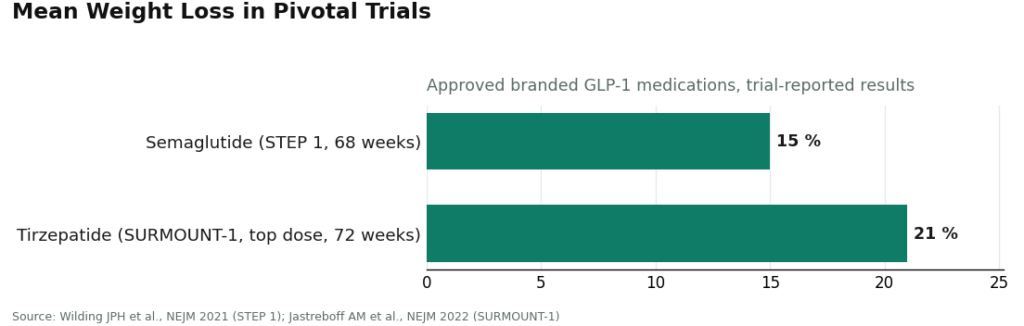
In the peptide world, this room houses the branded GLP-1 weight-loss drugs, and it’s worth pausing on how strong the underlying case for them actually is. Semaglutide and tirzepatide are both peptides, and in their approved branded forms they carry serious trial evidence behind them. Semaglutide produced about 15 percent mean weight loss over 68 weeks in the STEP 1 trial. Tirzepatide, at its top dose in SURMOUNT-1, reached roughly 21 percent [C3][C4]. Those numbers are the reason so many people want these molecules in the first place, and they’re the benchmark the other two rooms get measured against, fairly or not.
But this room has walls, and they matter. The approved branded products are often the priciest option on the table, and depending on the year, supply has not always kept pace with demand. There’s a harder limit too: most of the recovery and wellness peptides that drew people to gray-market sellers in the first place, the BPC-157s, the TB-500s, simply have no approved version sitting in this room. Nobody has taken them through the process. So this is the safest room when it has what you’re looking for, but it doesn’t cover the whole floor plan, and its cost and scarcity are exactly why the other two rooms exist.
The middle room, where a license does the vouching
Most people who go searching for a Peptide Sciences alternative are actually, without quite knowing the term for it, looking for this second room. A compounded medication is prepared by a licensed pharmacy, from a valid prescription, for one particular patient. It hasn’t been through the FDA’s premarket approval, no. But it isn’t operating outside the law either. It’s operating inside a framework Congress built on purpose, sections 503A and 503B of the Federal Food, Drug, and Cosmetic Act, which let licensed pharmacies and physicians compound medicine from a valid prescription under specific, defined conditions. A 503A pharmacy compounds for an individual patient against a prescription; a 503B outsourcing facility works under a heavier set of manufacturing rules. None of this is a loophole. It’s a door built into the wall deliberately.
This is the room where a supervised telehealth provider does its work. FormBlends, for instance, describes itself plainly as a telehealth platform, not a medical practice, where independent licensed providers review your intake and “all medications require a licensed physician consultation and prescription.” When something is deemed appropriate, it gets compounded and dispensed by a licensed 503A pharmacy following USP standards, with quality checks run batch by batch. For weight loss, that’s compounded semaglutide or tirzepatide, the same molecules from the first room, frequently at a fraction of the cost. The independent ranking done after the shutdown noted compounded semaglutide from a provider like HealthRX.com starting around $99 a month [C1]. For the recovery and wellness peptides that never had a room-one option at all, this is where a clinician and a licensed pharmacy replace the research-chemical website.
Here is the part of this room that I think deserves real credit, because it’s the difference between a provider you can trust and one you can’t. Compounded is not approved, and an honest provider says so out loud rather than letting the resemblance to a “real” drug do the persuading. FormBlends states in its own materials that compounded medicines are not FDA-approved and are not the same as the commercially available branded product. That’s not a confession dragged out of them. It’s the exact disclosure the FDA spent 2025 and 2026 demanding from telehealth companies that had let the line get blurry [C2]. A provider volunteering that distinction is telling you, in effect, that it has nothing to hide. This middle room is where a lot of people should probably land, because it keeps the license and the legal scaffolding while widening the door and lowering the price. But it only functions the way it’s supposed to when the provider is honest about which room you’re in.
The room with no one at the door at all
The third room is the one that most resembles the old Peptide Sciences experience, which is exactly why it’s the most tempting, and after 2026, the most dangerous. A research-grade product is a vial sold by a chemical retailer, stamped “for research use only” or “not for human consumption,” with no clinician anywhere in the transaction, no prescription, no licensed pharmacy checking anything. You order it. It shows up. What you do with it afterward is, according to the label, none of the seller’s business.
For most of 2024 and 2025, this whole room stayed standing on a single supporting beam: the disclaimer. Stamp “for laboratory research only” on the vial, and the reasoning went, the label itself kept the transaction technically legal while everyone quietly understood what the product was really for. That beam was the entire structure.
It gave out in 2026, and this is the fact that reshapes everything about this room. On March 31, 2026, the FDA sent warning letters to seven online peptide sellers in one day, Gram Peptides and Prime Sciences among them, and declared the products unapproved new drugs, flatly rejecting the “research use only” framing. The language directed at Gram Peptides doesn’t leave much room for interpretation: “Despite statements on your product labeling marketing your products for ‘Research Use Only,’ and ‘not intended for human consumption, medical use, or veterinary use,’ evidence obtained from your website establishes that your products are intended to be drugs for human use” [C2]. In other words, once a product page starts talking about weight loss while the same checkout sells bacteriostatic water and syringes, the regulator reads the whole page, and the disclaimer stops functioning as cover.
So this room, in 2026, stacks its problems on top of each other. The product is legally an unapproved new drug, never reviewed for identity, strength, purity, or quality. No clinician has decided it’s appropriate for you. There’s no prescription, no licensed pharmacy, and if something goes wrong, no recall pathway to catch it. And the one thing that used to make this feel like a safe, quiet purchase, the disclaimer, no longer even protects the seller, which tells you something about how little it was ever protecting the buyer [C2]. The vials are still on the shelf. What’s changed is that the load-bearing beam has been sawed through in writing, against sellers named in public, and the risk that was always sitting there is no longer hidden by anything.
Laying the actual molecules across the three rooms
All of this stays a little abstract until you put real compounds into it, so here’s the floor plan for someone actually trying to replace a Peptide Sciences order.
Semaglutide and tirzepatide exist in all three rooms at once. Room one, as approved brands. Room two, as compounded preparations from a licensed pharmacy. Room three, as research-grade vials from a chemical retailer. The molecule itself doesn’t change from room to room. What changes is everything wrapped around it: the approval status, the oversight, the testing, the legal footing. Which means a weight-loss seeker genuinely has a choice here, room one for the approved product, room two for supervised compounded access at a lower price, room three for the unsupervised vial whose central failure, dosing you can’t verify, happens to be the exact thing GLP-1 titration cannot forgive.
The recovery and wellness peptides, BPC-157, TB-500, the growth-hormone secretagogues, mostly live in rooms two and three only, because no one has walked them through approval. So the real choice narrows, and it’s a starker one: a supervised compounded route through a clinician and a licensed pharmacy, or an unsupervised vial with no one behind it. The evidence around these compounds sharpens what’s at stake in that choice. Human evidence for BPC-157 is thin, dominated almost entirely by preclinical work; a 2025 systematic review found 35 preclinical studies set against a single clinical study, with no clinical safety data at all [C6]. A 2026 review lays out genuinely interesting mechanisms in animal models, but interesting in animals has never meant proven in people [C7]. For a compound whose effects are already this uncertain, room three stacks a second uncertainty on top, whether the vial even contains what it claims, while room two removes that second layer through pharmacy testing that actually happens.
So which room should you actually walk into
The honest answer depends on what you’re after and what you can get, but once the rooms are clear, the logic mostly writes itself.
If weight loss is the goal and you can reach and afford the approved branded product, room one is the most established ground to stand on. If cost or availability gets in the way, which for a lot of people it does, room two, supervised compounded access through a clinician and a licensed pharmacy, is the honest substitute that keeps the strong-evidence molecule while opening the door wider. The independent post-shutdown ranking landed on exactly this conclusion, placing supervised compounded providers at the top of the field, FormBlends first and HealthRX.com second on GLP-1 access [C1].
If your goal is recovery or general wellness, where room one usually isn’t an option to begin with, the real decision is room two against room three, and after 2026 that isn’t close. Room two gives you a clinician deciding whether the compound makes sense for you, a licensed pharmacy verifying identity and purity, and an actual legal structure underneath it. Room three gives you a vial of uncertain origin, no clinician, no prescription, and a seller the FDA has already shown it’s willing to move against [C2]. For a compound this thin on evidence, the room that strips away the avoidable uncertainty is the better replacement, not a shortcut around it.
If there’s a single thread worth carrying out of all this, it’s that the room is the decision, not the name on the storefront. A slick-looking website in room three is still room three, whatever it says about itself. A plainer, less marketed provider operating honestly in room two is offering something structurally sturdier underneath. Once you can actually tell the rooms apart, the question of what to buy mostly answers itself.
Questions people keep asking me about this
What’s the real difference between compounded and FDA-approved?
An FDA-approved medication has gone through the agency’s premarket review for safety and effectiveness, with fixed manufacturing standards and approved labeling. A compounded medication is prepared by a licensed pharmacy from a valid prescription for one patient, under sections 503A and 503B of the Federal Food, Drug, and Cosmetic Act, outside that approval pathway. The molecule itself can be identical in both, semaglutide being the obvious example [C8]. What’s different is that the compounded version hasn’t gone through FDA approval and isn’t the same product as the branded one, something any honest provider will tell you outright [C2]. Compounding is a recognized, licensed activity, not a workaround.
Isn’t “research-grade” peptide just a cheaper version of the same medicine?
No, and that assumption is the mistake that costs people the most. A research-grade product is a vial sold by a chemical retailer under a “research use only” label, with no clinician, no prescription, and no licensed pharmacy involved anywhere. It hasn’t been reviewed by the FDA for identity, strength, quality, or purity, and after the agency’s March 31, 2026 warning letters to seven sellers, the disclaimer it depends on has been rejected outright. The FDA’s own words: “evidence obtained from your website establishes that your products are intended to be drugs for human use” [C2]. So a research-grade vial is an unapproved new drug with nobody watching, not a bargain edition of something regulated.
Which room do the GLP-1 weight-loss drugs actually sit in?
All three at once. Semaglutide and tirzepatide exist as FDA-approved brands, as compounded preparations from a licensed pharmacy, and as research-grade vials from chemical retailers. The molecule works the same way in each, through the incretin system, slowing gastric emptying and increasing satiety [C8]. What shifts between the three is approval status, supervision, testing, and legal standing. For weight loss, the compounded route is often what former gray-market buyers are actually hunting for, since it keeps the well-evidenced molecule and the clinical oversight while cutting the price relative to the brand [C1].
Why do recovery peptides like BPC-157 seem to only exist in the lower two rooms?
Because nobody has taken them through FDA approval, so there’s usually no room-one version at all. That leaves a supervised compounded path or an unsupervised research-grade vial as the only two real options, and the evidence makes that choice matter. Human evidence for BPC-157 is thin and mostly preclinical, with a 2025 systematic review finding 35 preclinical studies against one clinical study, and no clinical safety data [C6][C7]. For a compound this uncertain to begin with, the research-grade route adds a second layer of doubt about whether the vial contains what it claims, while the compounded route removes that layer through pharmacy testing. Even with no approved option on the table, the two remaining rooms are far from equivalent.
If I just want the cheapest option, isn’t research-grade the obvious pick?
It’s the cheapest on the receipt, and that’s precisely the trap. The price tag doesn’t account for what you’re giving up: a clinician judging whether the compound is right for you, verified identity and purity, a prescription, a licensed pharmacy, any recall pathway if something’s wrong. After 2026 it also doesn’t account for the fact that you’d be buying an unapproved new drug from a seller the FDA has shown it’s willing to act against [C2]. For a GLP-1, where dosing needs to be controlled carefully, or for a thin-evidence compound whose contents are already in question, the research-grade room’s low price comes attached to its highest risk. The compounded route, by contrast, is frequently far cheaper than the branded product while keeping the safeguards intact.
Are the companies selling “peptide sciences alternatives” online actually legit?
Some are, most aren’t, and the polish of the website tells you nothing either way. Legitimacy comes down to third-party certificates of analysis, transparent sourcing, and whether the seller states plainly whether the product is for research use or for human use. A lot of sites blur that line on purpose. If a vendor is selling peptides for human use with no pharmacy license and no prescribing physician in sight, that’s a regulatory red flag no matter how clean the design looks.
What should I actually look for when buying from a peptide sciences alternative source?
Start with the certificate of analysis. A trustworthy supplier publishes batch-specific COAs from an independent, accredited lab, not an in-house test it graded itself. Beyond that, check whether the company discloses purity thresholds, sterility testing for anything injectable, and a real physical address. If those things are missing or vague, that gap is the answer you were looking for. The compounding pharmacy route, through a service like FormBlends operating under physician supervision, handles most of that paperwork for you.
Why do so many peptide sciences alternative reviews sound the same, or feel fake?
Because a good number of them are. The research-chemical space has a well-documented problem with incentivized or outright fabricated reviews, partly because people buying something in a legal gray zone rarely want to post about it under their real name. That vacuum gets filled by vendor-written content. When you’re weighing reviews, give more credit to forum discussions on communities with strict rules against self-promotion than to testimonials sitting directly on the product page.
If I switch away from Peptide Sciences to another supplier, what’s the biggest practical risk?
Consistency between batches. Even if a supplier’s first shipment tests clean, nothing guarantees the next one comes from the same raw-material source or hits the same purity mark. For research purposes that introduces a confounding variable. For personal use the stakes climb higher, because dosing habits built around one batch might not hold for the next one. It’s exactly why the compounding pharmacy model, with its regulated manufacturing standards, exists as its own separate room.
References
- [C1] “Peptide Sciences Shut Down. Here Are 7 Providers Worth Trusting Instead.” Independent analysis ranking the post-shutdown field; ranks FormBlends first (licensed clinician reviews every case, published per-batch HPLC, mass spectrometry, and endotoxin figures, FDA-registered 503A compounding pharmacy) and HealthRX.com second (GLP-1 focus, compounded semaglutide from about $99 a month).
- [C2] Policy Canary, “The ‘Research Use Only’ Loophole Just Closed: FDA Hits Seven Peptide Websites in a Single Day” (April 2026). Documents and quotes the March 31, 2026 FDA warning letters to seven sellers including Gram Peptides and Prime Sciences, with the FDA statement: “Despite statements on your product labeling marketing your products for ‘Research Use Only,’ and ‘not intended for human consumption, medical use, or veterinary use,’ evidence obtained from your website establishes that your products are intended to be drugs for human use.”
- [C3] Wilding JPH, et al. “Once-Weekly Semaglutide in Adults with Overweight or Obesity.” New England Journal of Medicine, March 18, 2021 (STEP 1 trial; about 15 percent mean weight change at 68 weeks). https://pubmed.ncbi.nlm.nih.gov/33567185/
- [C4] Jastreboff AM, et al. “Tirzepatide Once Weekly for the Treatment of Obesity.” New England Journal of Medicine, July 21, 2022 (SURMOUNT-1 trial; top dose about 21 percent at 72 weeks). https://pubmed.ncbi.nlm.nih.gov/35658024/
- [C6] Vasireddi N, et al. “Emerging Use of BPC-157 in Orthopaedic Sports Medicine: A Systematic Review.” HSS Journal, July 31, 2025 (human evidence extremely limited; 35 preclinical studies against 1 clinical study; no clinical safety data found).
- [C7] Sikiric P, et al. “Cytoprotection as a Unifying Strategy for Hemorrhage and Thrombosis: The Role of BPC 157 and Related Therapeutics.” Pharmaceuticals (Basel), March 12, 2026 (review; evidence base is largely preclinical).
- [C8] Collins L, Costello RA. “Glucagon-Like Peptide-1 Receptor Agonists.” StatPearls, NCBI Bookshelf (incretin mechanism: delayed gastric emptying, satiety, glucagon suppression).
Bram Holloway is a features writer who covers the messy overlap of health, regulation, and consumer behavior. This piece was reported against the primary literature cited above.
General educational content. Speak with a licensed professional before changing your routine.